
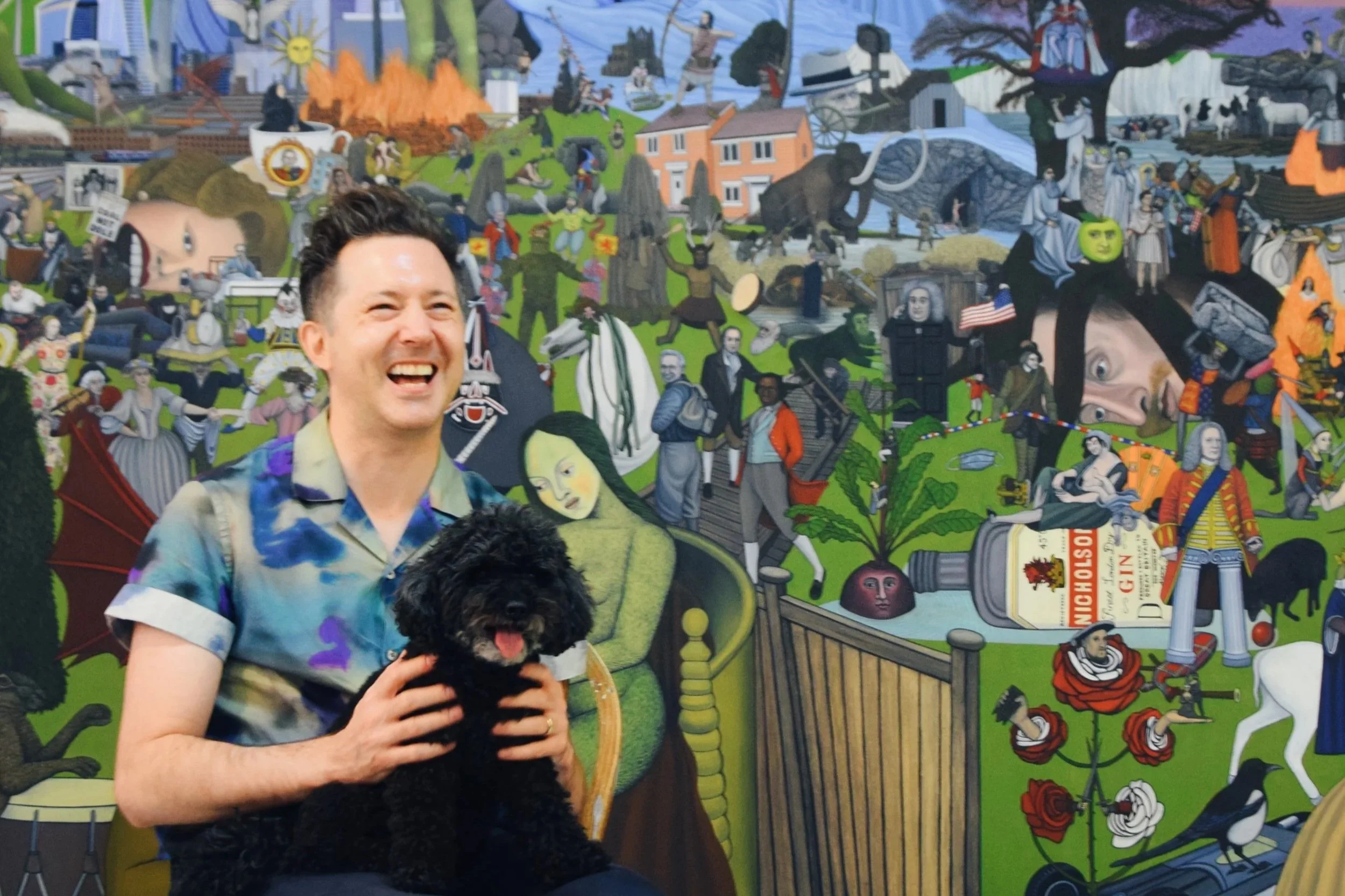
Ben Edge in front of his painting ‘Children of Albion’.
A RETELLING OF THE LIFE & TIMES OF BEN EDGE
ARTIST, MUSICIAN & FILMMAKER - CHRONICLER OF FOLK IN BRITAIN - CREATOR OF A NEW TRADITION
Words by Nina-Sophia Miralles - Rhymes by Wang Sum Luk
The artist Ben Edge is a dapper dresser, but his father’s style is rip-roaring. That’s not the only colourful quality that’s been passed down the paternal line: the Edges can spin yarns. ‘I grew up in a family of great storytelling eccentrics,’ he shares. ‘My grandfather was the same, so I’ve always been fascinated by how people become who they are.’
As Edge’s best-known works—paintings devoted to British folklore and remixes of historical tradition—gain nationwide attention, he’s gathered fans from all walks of life. His singular style is a kind of storytelling in visual form, a lusciously painted topography of symbols that speaks to curious laymen and art insiders alike. But who was Edge before he burst onto the scene with his 2017 breakout show? What of his trials and tribulations? In short, how did he become Ben Edge, artist?
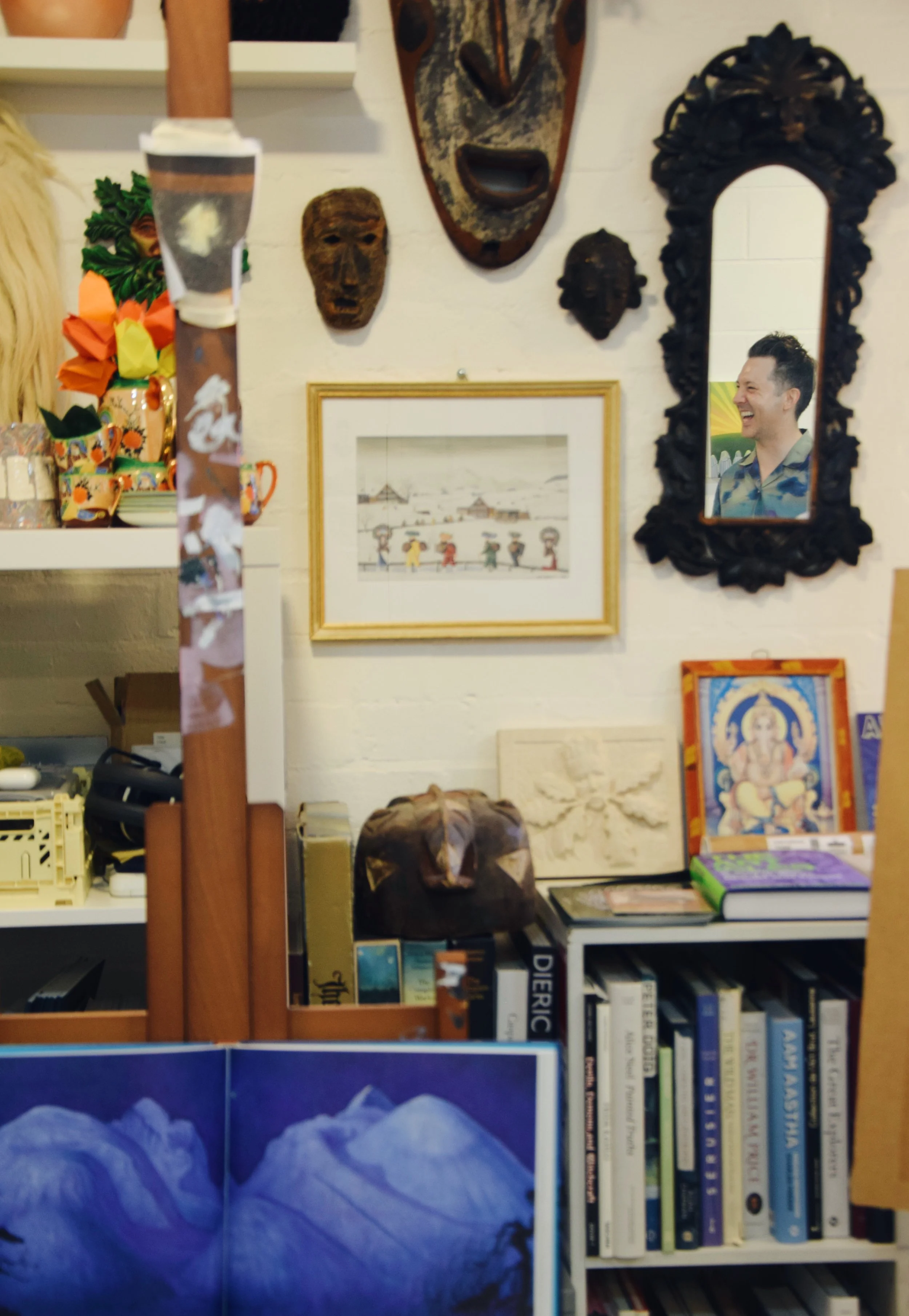
Ben Edge in his studio.
‘I’ve always been fascinated by how people become who they are.’
It may be sheer trifling silliness to treat a modern painter as the subject of a heroic saga. Yet the unlikely journeys that shaped Edge’s career and character have the ring of the mythical, of a destiny guided by fates. Perhaps we’ll even find pearls of wisdom whose value can be shared.
Of Ben’s first folk creations, and the fruit
Of his ingenious mind, whose endless turns
Brought art before our eyes, and to our screens,
Sing, Journalist’s Muse, that in verses I
May justify the art of Ben to men…
To begin at the beginning: Edge had a split childhood between Kent and London, though he chose to remain in the capital for higher education. He didn’t go to ‘any of the fancy art schools’, completing his BA in Fine Art at London Metropolitan University. The upside was Whitechapel. It was an ‘amazing’ time to be there – then the raw beating heart of the capital’s contemporary art scene, strewn with late-night gallery openings and indie shows, not to mention access to the brilliant old-school eccentrics who gathered in the Castle, a pub much-frequented by students, where Edge sunk his share of pints.
But all was not plain sailing. ‘I struggled with the very conceptual art world,’ he admits. ‘I had a chip on my shoulder, because I thought people were looking down on what I was doing. I was developing the style I have now, so I was making folky-style paintings.’ Scouring street markets for old black-and-white photographs to copy, Edge felt an ongoing pressure to make his work ‘intellectual’. ‘Every time I tried to come up with these “great” ideas it blocked my creativity,’ he says. ‘It’s traumatic as an artist to experience a block. You feel your whole world’s collapsing.’

Ferdinand Cheval (2010)
‘I’m interested in ordinary people doing extraordinary things. It’s anti-celebrity.’
The soul-searching didn’t stop after art school, but Edge had bills to pay. ‘I was in a band in my 20s,’ he shares. ‘We had a record deal and we toured Europe, but we weren’t making a living, so I always had other jobs.’ His CV makes for eclectic reading: he’s worked at a posting depot and a vintage boutique. He’s handed out flyers and pitched in at his brother’s graphic design studio. Yet all along, he continued practising painting in secret…
Is this the career, this the toil and time,
Asked Ben of himself, that may well defeat
Ambitions of my art? This tedious gloom
Is what my mind must fight. My thoughts must break free,
Or else forever in shadows be hid.
One day, Edge pulled a book off his shelf called Raw Creation. It fell open to the story of French postman Ferdinand Cheval, who overcame personal tragedy to build an intricately decorated structure that he called Le Palais Idéal (the Ideal Palace). This magnificent feat of imagination was mostly constructed from pebbles collected on his postal rounds. Cheval worked for 33 years to bring it to life.
Inspired, Edge painted a portrait of Cheval, which then led to a series on outsider artists. ‘I’m interested in ordinary people doing extraordinary things,’ Edge explains. ‘It’s anti-celebrity.’ The ‘Outsider’ project showcases Edge’s early style, characterised by bold strokes and a deliberate lack of depth. These naïf qualities evolved in his next series, ‘Folk Renaissance’, which feels more confident, though the bright flat colours and thick outlines continue to give the paintings an illustrative feel. This second body of work showed folk heroes within mythologised tableaux that told the story of their lives.
Ramblin’ Jack Elliot, a singer who was born in New York but loved cowboy culture, is imagined in a backdrop combining the Big Apple and a desert plain. Arctic explorer Robert Peary appears as an upright gentleman in the foreground, flanked by scenes of his childhood in Maine, and his adulthood living with Inuits. Time is compressed into a snapshot: this is what it would look like if we could zoom out and take in a whole life by telescopic view.
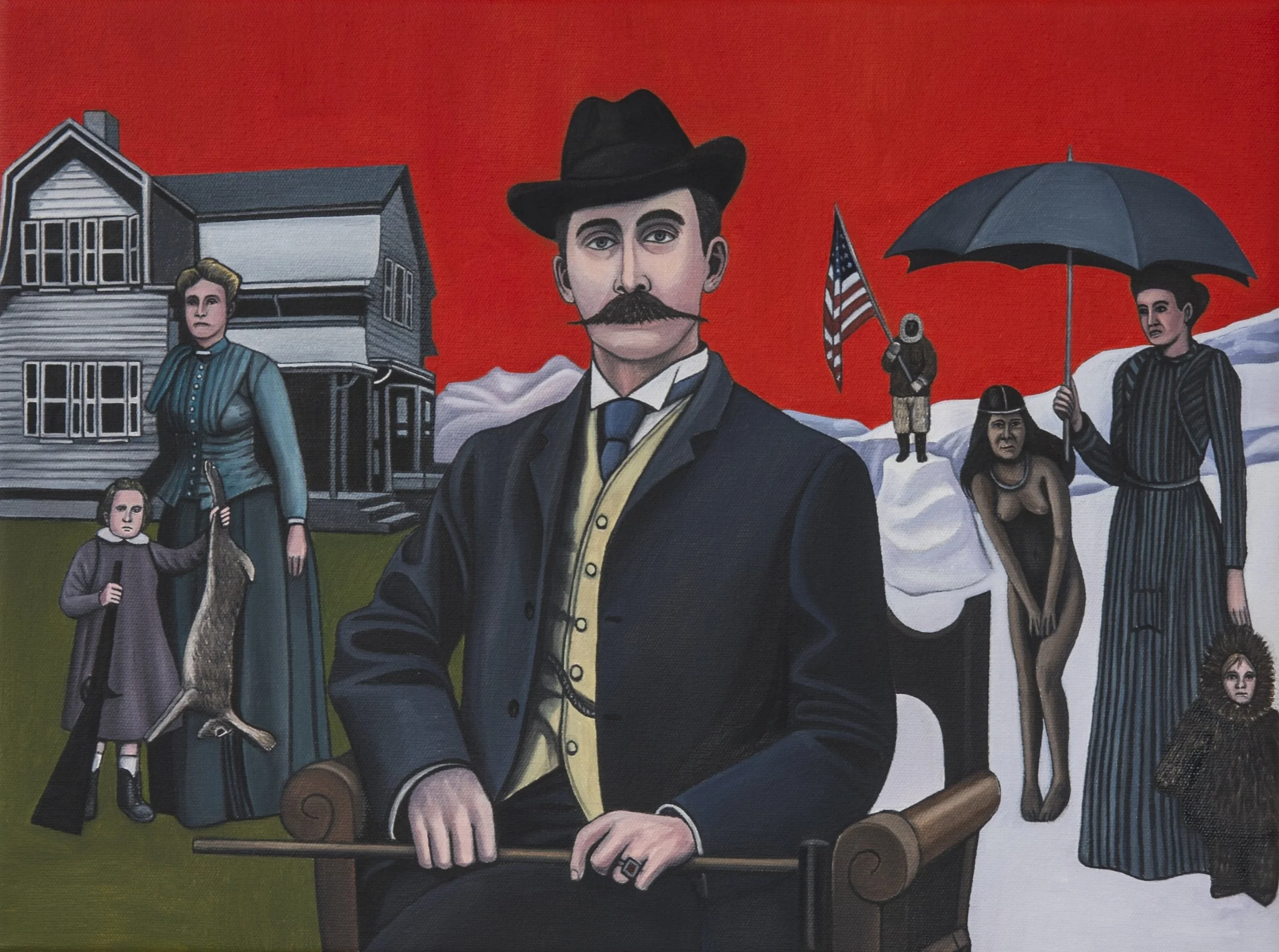
The Life of Peary (2015)
‘I love religious art,’ he notes. ‘We’re often not taught the stories of the symbols—the painting within the painting—but we feel something. We can usually guess the story.’ Similarly, even if we don’t know the biographies of Edge’s subjects, we can guess something of their world from the animals, outfits, scenes and signs Edge interweaves into their portraits. In fact, the paintings are more like portraits of a life rather than portraits of a person. ‘It transcends language. It’s a symbolic space, like dreams.’
‘It transcends language. It’s a symbolic space, like dreams.’
‘Folk Renaissance’ would become his first exhibition, but Edge still hadn’t released any of his art. ‘I was sacked from a job as a labourer,’ he reminisces. ‘Halfway through painting a flat they decided to get someone more professional in, and I got axed on New Year’s Day.’ This abrupt end to his dubious career as a builder, where he picked up the nicknames ‘Weak-As-Piss’ and ‘Picasso’, left him broke and still amid a ‘mental health wobble’. Edge said to himself: ‘Nothing can be worse than this. Being an artist shouldn’t scare me now.’ So he decided to go for it.
Despite the arduous days of job-search plight
He strove hard, and his mind for ceaseless hours
Disputed, to devise and to commence
Works where folk art might express and tell
Things only visible to artists’ sight.
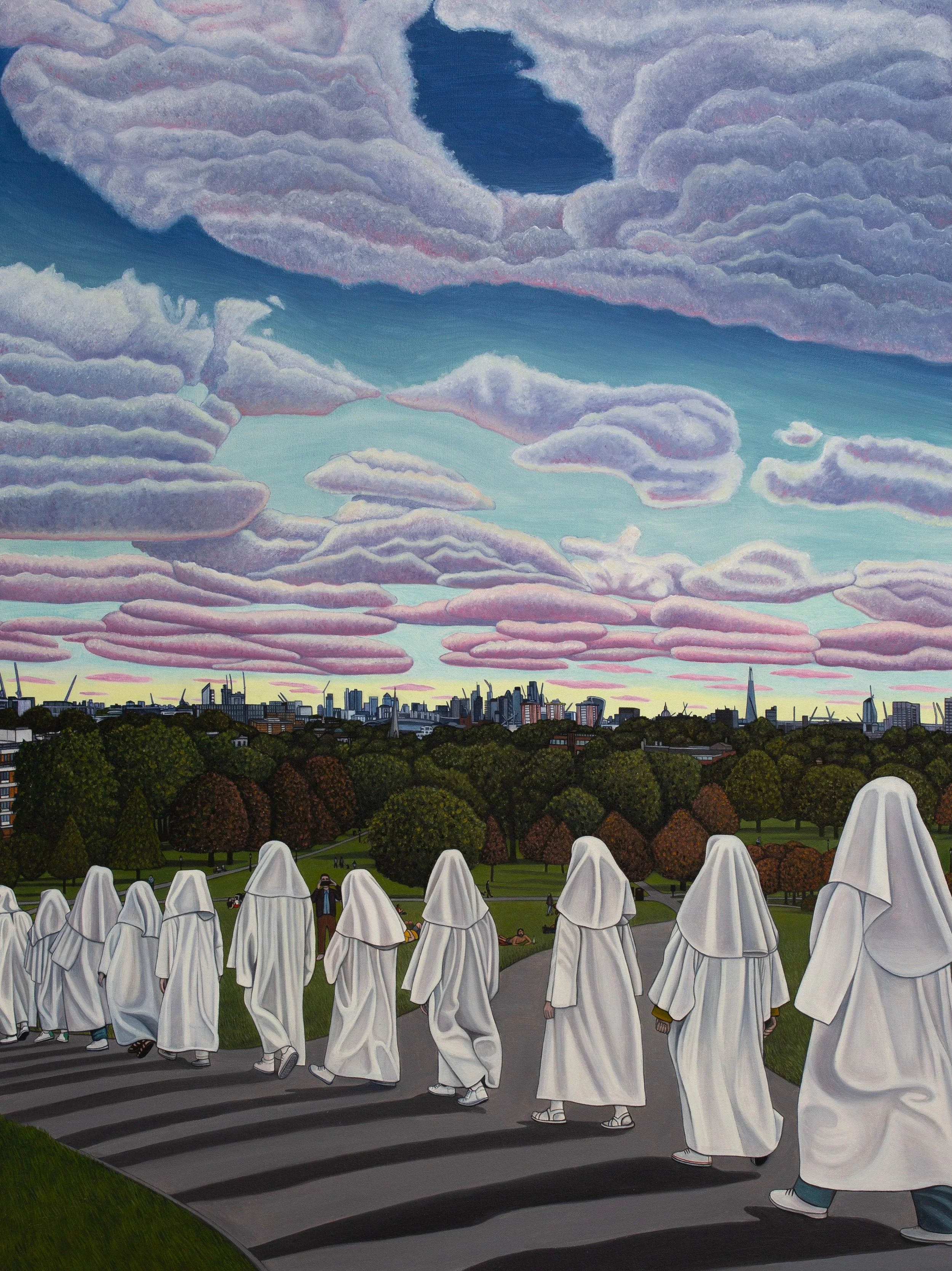
The Autumn Equinox (2018)
‘At the beginning, I’d do anything to make a living,’ Edge shares. ‘I did pet portraits even. I was ringing everyone I knew.’ Early successes on social media helped pave the way, much to his surprise. ‘When I was in a punk band we made this song that was an attack on social media… and yet ironically, the minute I started posting online, it changed my life.’
This druid epiphany, or ‘Druid-phany’ as Edge calls it, woke him up to a world he was disassociated from — one fuelled by tradition and connection to nature.
Twists of fate kept him on the right course. He met like-minded people across the world, including a Pittsburgh collector who became an early supporter, commissioning a portrait of artist John Kane. But just as he began to hit his stride, his love of the outsider-inspired works began to fade. ‘I got to a point where I kept asking, who shall I paint next?’ It was the wrong energy for a theme that had once galvanized him. But one day, on his way to paint the Tower of London’s Master of Ravens, he stumbled across a scene straight out of Arthurian myth.
A formation of white-cloaked druids were chanting, ushering in the spring equinox by scattering seeds, a neopagan rite that looked wholly transposed from a more ancient time… except for the fact they were assembled near a Wetherspoon’s. This druid epiphany, or ‘Druid-phany’ as Edge calls it, woke him up to a world he was disassociated from—one fuelled by tradition and connection to nature. A mysterious, ritual-filled Britain beckoned him.
Out of a Druidic ritual, light began
To animate Ben’s mind, and from his soul
Ideas sprang, rising like flames, the sign
Of projects new: of works that would be proud
Of ancient custom, yet help new truths grow.
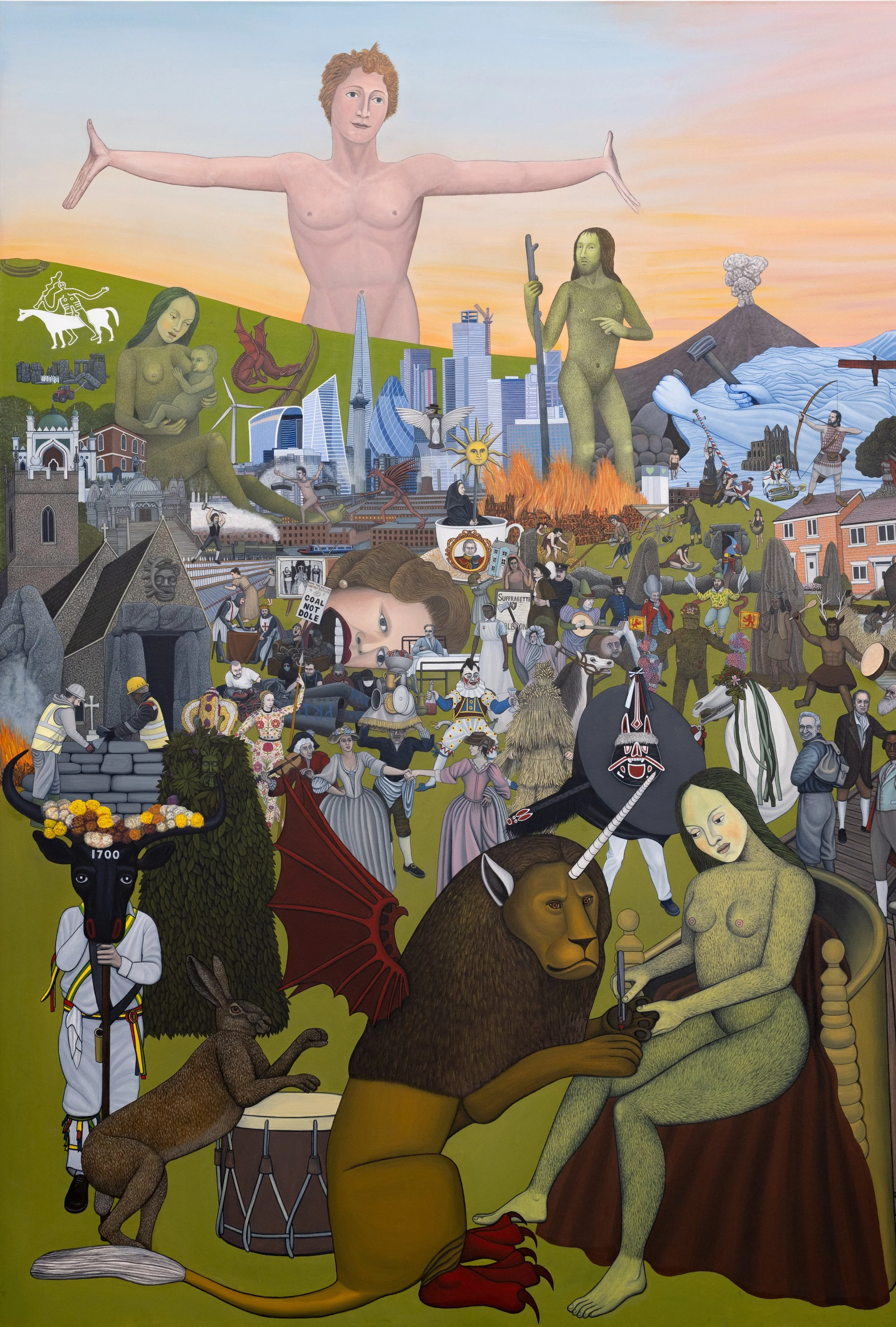
Details from ‘Children of Albion’. Image credit: Ben Deakin Photography
‘I found my style in my 20s and my subject matter in my 30s. I can see that taking me through the rest of my life,’ Edge asserts. Since becoming a kind of unofficial portraitist of folk, a fan and a chronicler of rituals across the British Isles, one might say that Edge has arrived. His most recent solo show in November 2025, a headline-grabbing blockbuster titled ‘Children of Albion’ and hung in the storied Fitzrovia Chapel, confirmed his place at the forefront of a movement.
Over the past few years he’s released a book, contributed to Taschen and Hoxton Mini Press titles, and garnered adulatory coverage in most of the nationals. He sits on the Ffern Folk Foundation’s five-person guild as a ‘leading voice’, and in 2026, he contributed no less than six artworks for a show at the Saatchi Gallery. This is without counting a couple of documentaries and albums made along the way. Safe to say that despite a volatile art market, Edge has got… well, the edge.
‘In this climate of polarisation, tradition has given me the space to find a hopeful, unifying message.’
His scenes of folkloric Britain apply the technique established in his portraits: ‘I was looking at each tradition as a person with history, so I treated it in the same way. It was a natural progression to how I look at the world.’ His magnum opus for ‘Children of Albion’ is an immense canvas at 300cm x 200cm. It fuses iconography from British culture and mythology—a British Airways flight soars above Morris dancers and green-skinned giants—with allusions to this island’s troubled history, like slaves carrying cotton, sugar, and tobacco, or striking coalminers tumbling out of Margaret Thatcher’s mouth. ‘Six months in, I discovered I could have done with another year and a half working on it.’ He grimaces, remembering the gruelling sixteen-hour days devoted to painting.
Contrary to exclusionary visions of British identity, Edge believes his art can bring people together by showing how diverse our ‘mongrel nation’ is. ‘In this climate of polarisation, tradition has given me the space to find a hopeful, unifying message. And it’s made me feel contemporarily relevant as an artist.’
Yet despite his rising star, Edge still doesn’t have permanent gallery representation – usually preferring to organise his own shows. He also draws on his music industry experience by creating his own T-shirts, calendars, and other merchandise, a democratic (and commercial) approach to art. ‘I’m not anti-gallery,’ he clarifies, ‘I just didn’t want to sit around, waiting for someone to give me a career.’
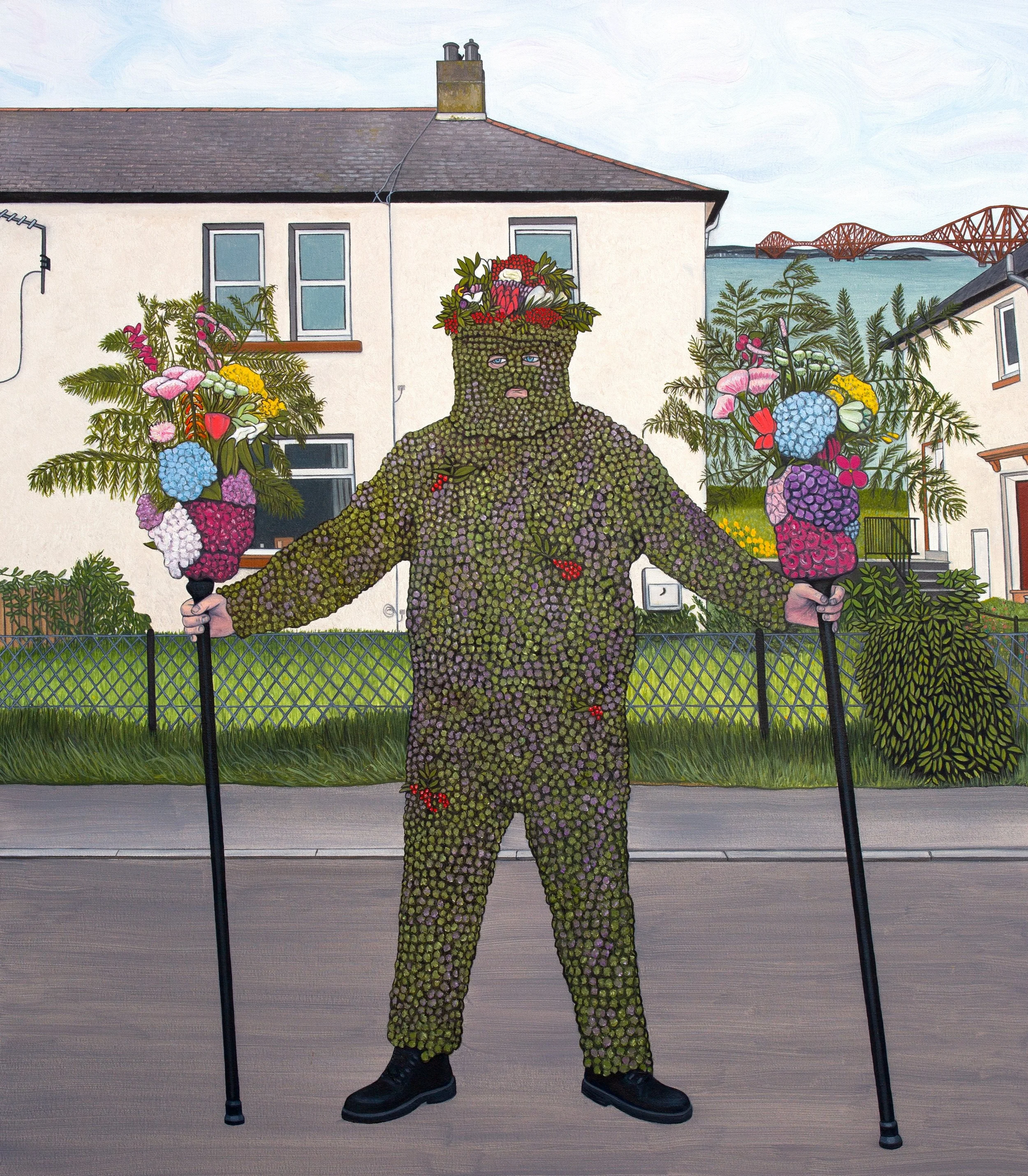
The Burryman (2018)
His self-starter mentality is the cornerstone to his success, and while Edge has never become a folk practitioner, existing rituals echo this personal philosophy. He cites the Burry Man festival from the Scottish town of South Queensferry, where a man dons a full-body costume covered in flowers and burrs, then is paraded on a nine-mile walk through the town and given (presumably much-appreciated) snifters of whisky.
Edge explains that the Burry Man represented a scapegoat who’d take away bad luck and bring in good, which would’ve historically helped villagers cope with troubles like bad harvests. ‘Maybe it would create a shift psychologically,’ he says of the ritual, ‘so you’d feel more positive and a solution to the problem would occur to you.’
‘ ‘As a painter, I need to be inspired all the time, so inspired that it drips out and feeds other people, inspiring them if they don’t have a luxury of their whole life being art.’
Edge seems to have achieved a similar transformation of circumstances, albeit without coating himself in burdock seeds. ‘It’s funny… All the things that happen in your life add up to something useful in a way you didn’t predict. There is an element of spirituality in how I think about life now; it’s almost like you have to be tested, to make sure you’re ready.’
The canvas spreads before Ben—what to draw?
On endless quest, with History his guide,
A brush in hand, his every sketch aglow,
Through Britain paints his solitary way.
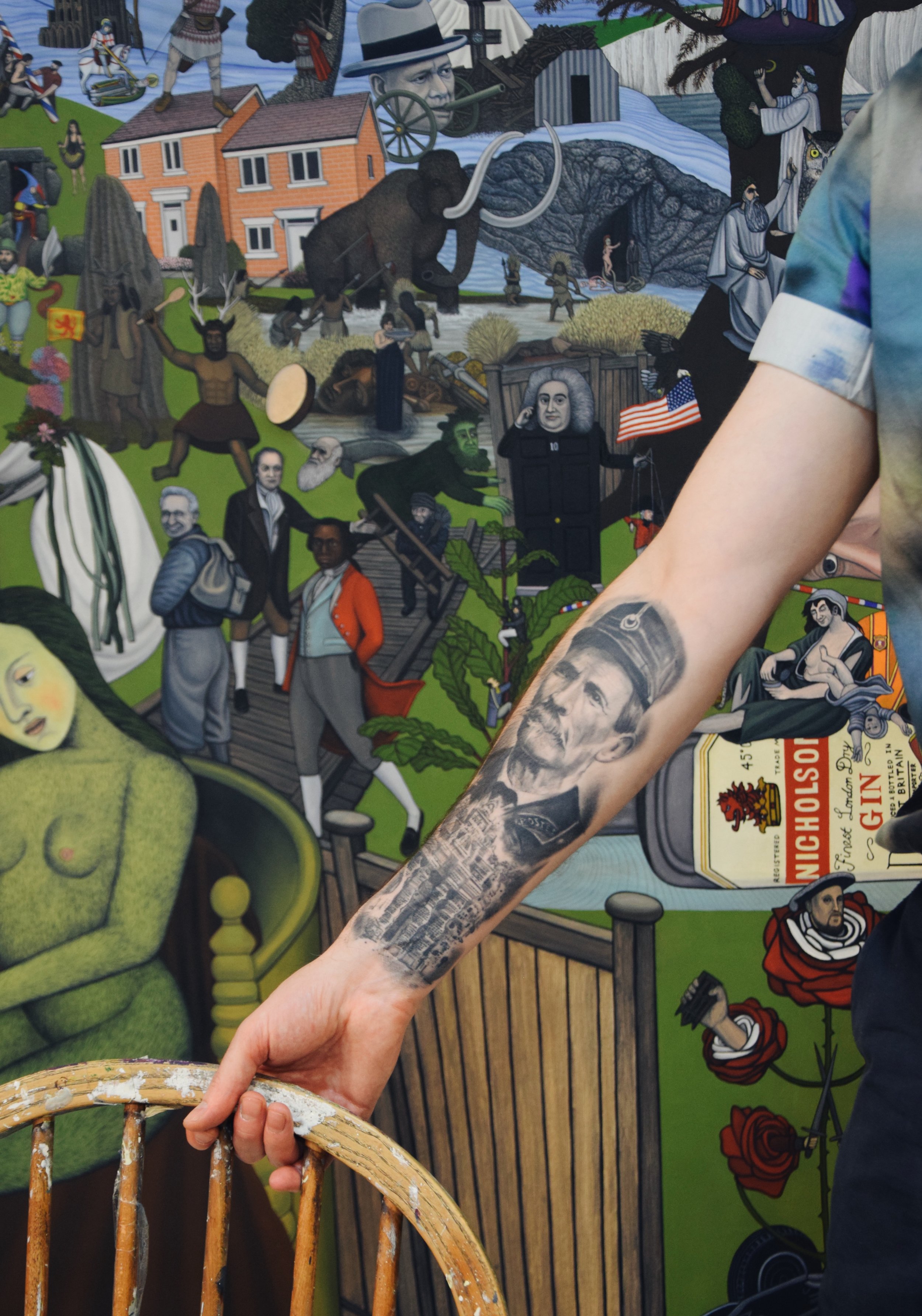
Ben Edge’s tattoo of Ferdinand Cheval
Edge seems destined to carve out an indelible space in contemporary British art. His recent works display a masterful self-assurance and sophisticated compositions that often overlap multiple points in history. His brilliant-bright colour palette has remained, though there are more countryside scenes, and luminous skies have become a mainstay.
‘My wife and I went to Iceland and the sunsets were about four hours long. I finally had enough time to study them,’ he explains. Dawn and twilight are transitional. Often thought of as ‘in-between worlds’ by spiritual people, they are shadowless moments in our daily life when magic can occur. The magic for Edge will always be art, and the answering echo it can create between people.
At this point in his career, sticking to his true nature as an artist is vital. ‘As a painter,’ Edge says, ‘I need to be inspired all the time, so inspired that it drips out and feeds other people, inspiring them if they don’t have a luxury of their whole life being art.’
Perhaps that’s why he has a tattoo of the French postman Ferdinand Cheval, who built the pebble palace, on his arm. It is no doubt a reminder of how he got here, and what amazing things can be achieved if you dare to trust your creativity.
Ben Edge’s next show is Ben Edge, The Pretty, the Ugly, and the Pretty Ugly at Kristin Hjellegjerde Gallery in Berlin, 9th January – 6th February 2027.