
Nine Muses, One Island: Visions Of Cyprus At XeniArtSpace
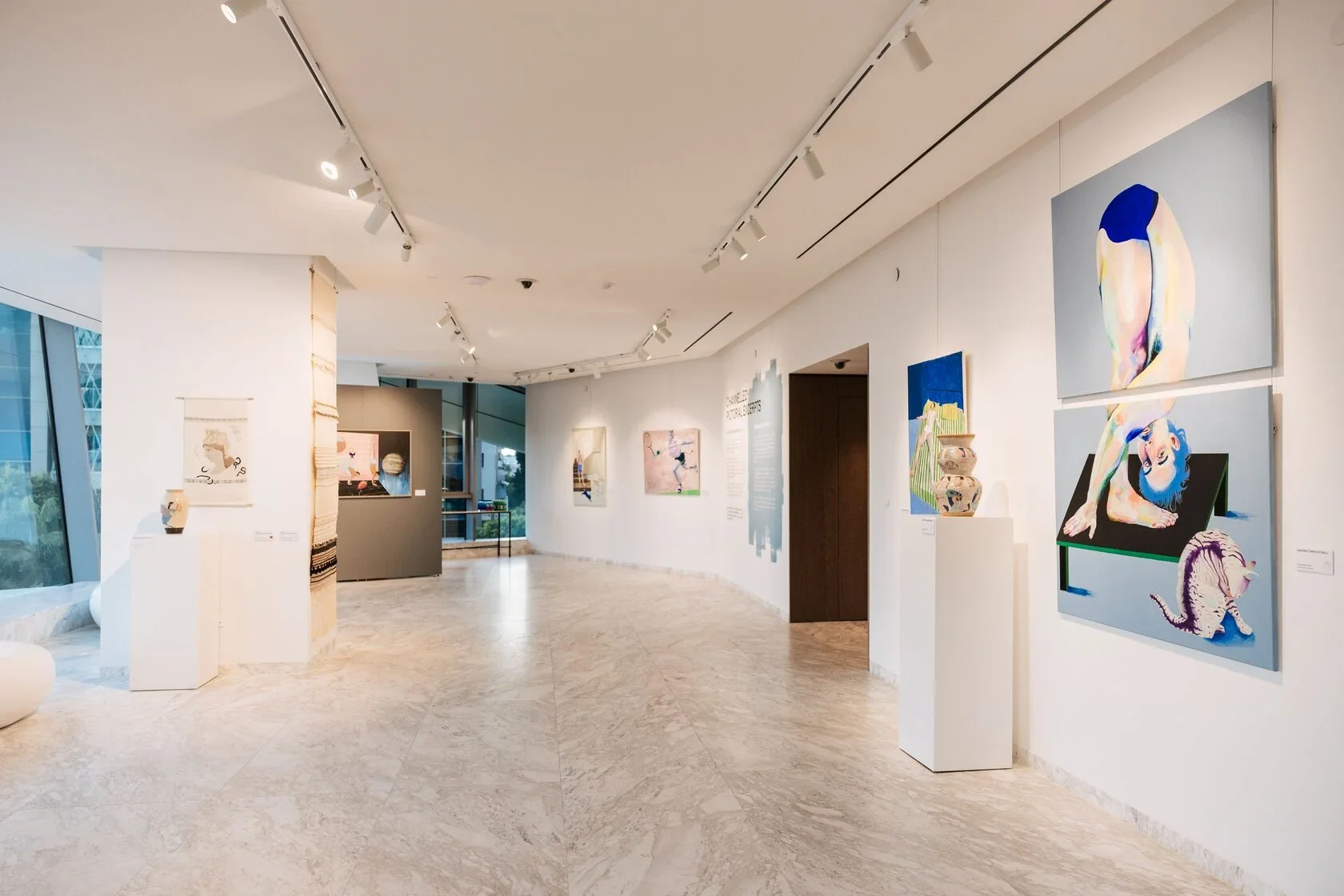
How do you paint a portrait of an island without actually painting it? Space 1 of CHANNELLED at XeniArtSpace offers nine answers (and then two more). Founded by Xenia Kulbachevskaya in Limassol, Cyprus, the gallery gives nine women artists a floor to explore the island, with another mother-daughter show upstairs.
Space 1 is a sister exhibition to the main CHANNELLED show in Space 2; and whereas the main show features international names like Tracey Emin, this exhibition spotlights artists connected to Cyprus. Some were born here; others arrived later. What they share is not so much a single vision of Cyprus, but the experience of carrying some version of the island with them.
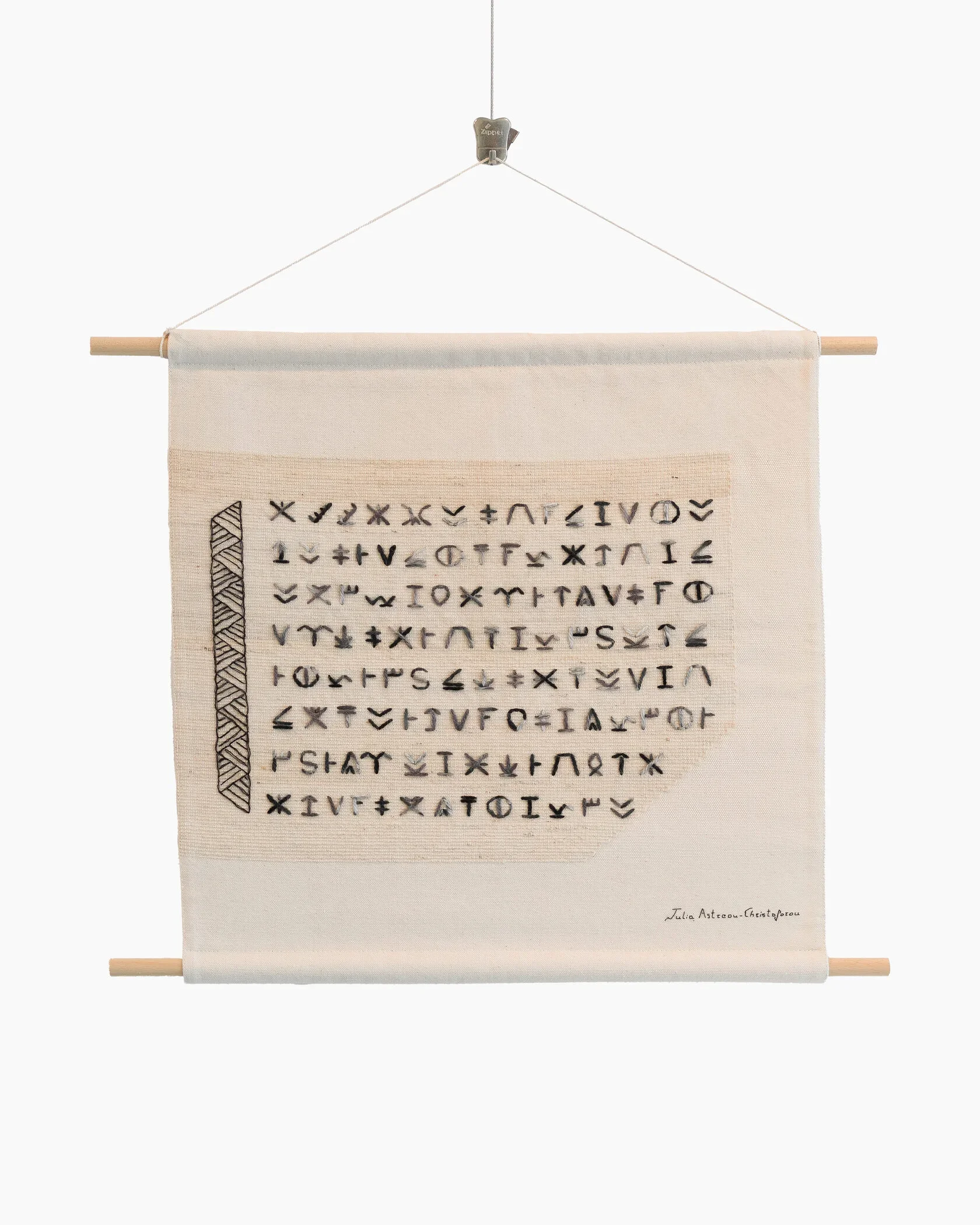
Julia Astreou-Christoforou, Cyprosyllabic Script
Nine is a fitting number. In Greek mythology, the Nine Muses were patrons of artists and the daughters of Mnemosyne, goddess of memory. Intentional or not, the parallel is hard to resist in an exhibition so interested in what is remembered, inherited, and passed on. These contemporary muses have traded scrolls and lyres for glass, ceramics, paint, and woven thread, but each tells the island's stories in her own way.
On the ground floor, CHANNELLED: CYPRUS — Women Artists of the Island brings together nine artists, each with a different background, experience, and artistic language. Upstairs, CHANNELLED: PICTORIAL EXCERPTS features another two names bringing inheritance close to home through the work of Daphne Christoforou and her mother, Julia Astreou-Christoforou. Their different artistic languages put memory and tradition in conversation across two generations.
What they share is not so much a single vision of Cyprus, but the experience of carrying some version of the island with them.
For both mother and daughter, the past is never very far away. It simply shows up differently. Julia Astreou-Christoforou spent more than two decades researching Cyprus’s textile traditions, and in Cyprosyllabic Script (2025), she quite literally weaves history into cloth. Ancient Cypriot characters stretch across cotton and wool, their neat rows a message waiting to be deciphered. But Julia isn’t interested in leaving tradition in the past.
Nearby, Artificial Intelligence (2025) leaps centuries forward with rows of binary code and circuit-like lines. Apparently, even a loom isn’t safe from AI. Perhaps there’s a warning woven in there too: technology has a way of turning up where you least expect it.
Her daughter, Daphne Christoforou, also looks to the past, only this time in the form of gods and monsters. They wander through her paintings, drawings, and ceramics, often looking surprisingly at home in the present. In Minotaur Plate (2026), the monster that once terrorised a labyrinth has traded menace for blue briefs and a rather relaxed pose. Suddenly, one of mythology’s most frightening creatures looks strangely ordinary. Christoforou doesn’t simply retell old stories; she plays with them, giving familiar characters contemporary lives of their own.
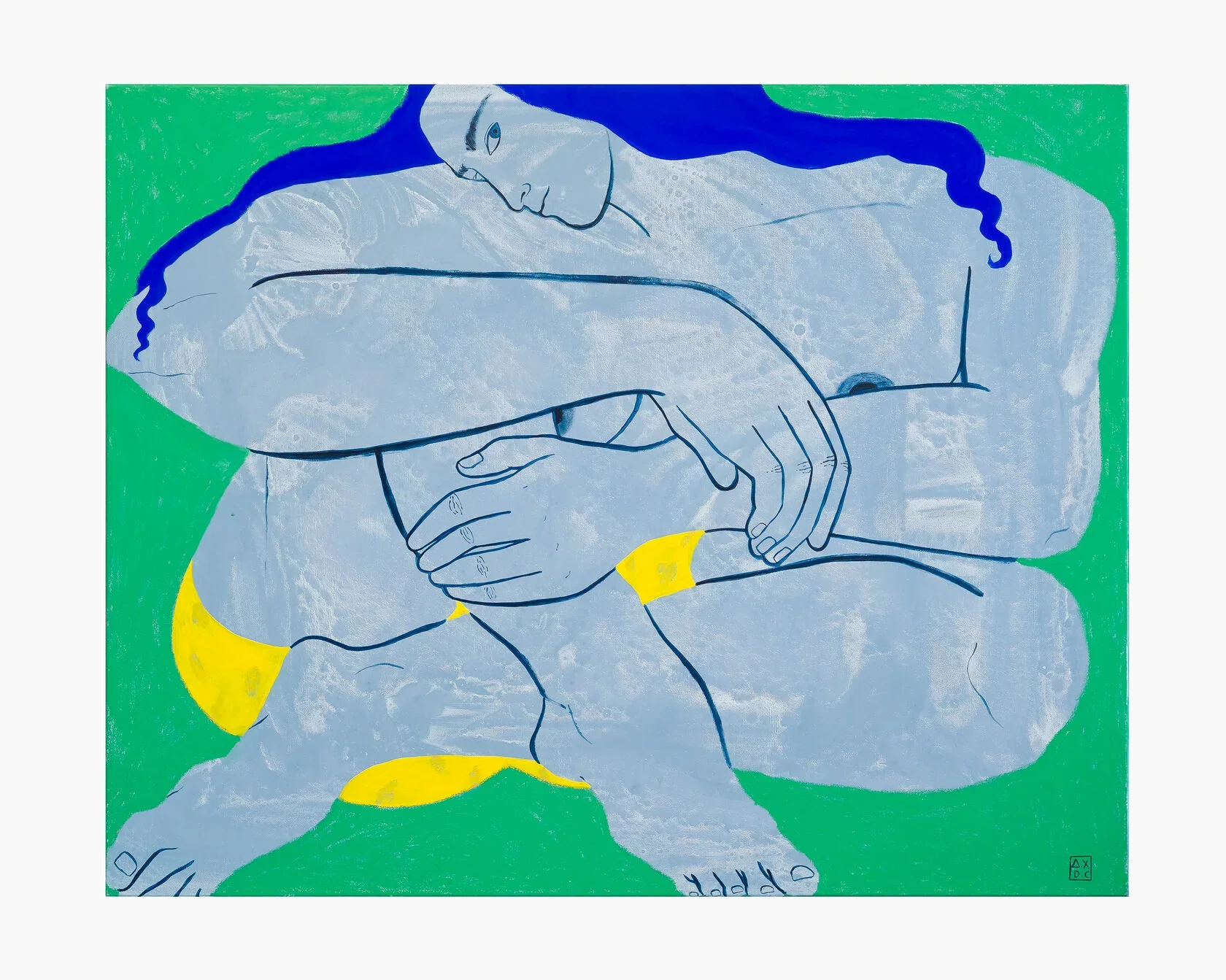
Daphne Christoforou, Hera (2025)
Sometimes an island is inherited through stories and language. Sometimes it is simply felt on the skin.
Summer in Cyprus (2025) needs no mythology. A figure lies sprawled across a striped bed, arms and legs flung in every direction, apparently defeated by the heat. Even getting comfortable seems like too much effort. It may be the simplest portrait of Cyprus on the floor, and one of the easiest to understand. Sometimes an island is inherited through stories and language. Sometimes it is simply felt on the skin.
Downstairs, the nine contemporary muses are waiting, each with her own version of the island. Andrea Charalambides begins with one of its prickliest inhabitants. In Sea Urchins (2026), Charalambides transforms the familiar marine form into something unexpectedly precious. Clear glass spikes surround a glowing center lined with 23-karat gold leaf, making the work look delicate and slightly dangerous. It is beautiful, but not exactly inviting to touch. That tension is part of the point: Charalambides takes a natural form built for protection and gives its guarded exterior a luminous core. Fragility and strength, it turns out, can occupy the same body.
Protection takes a softer form in Carolina Souss’s Eucalipto (2023). The Argentinian-born artist paints a young woman sitting cross-legged, her hair cascading past her waist in thick curtains that wrap her in a veil of her own making. Only her face and hands fully emerge from it. That curtain of hair becomes more interesting when the title comes into play. Eucalipto, the Spanish word for eucalyptus, carries Greek roots: eu, meaning ‘well,’ and kalyptos, ‘covered.’ The name makes sense when looking at the plant itself: its developing flower stays tucked beneath a protective cap until it is ready to emerge. Souss’s figure seems to be doing the same beneath her own curtain of hair. The artist made Cyprus her home in 2022, bringing a different kind of inheritance into the exhibition. An island, after all, doesn’t have to be inherited at birth. It can also become home.
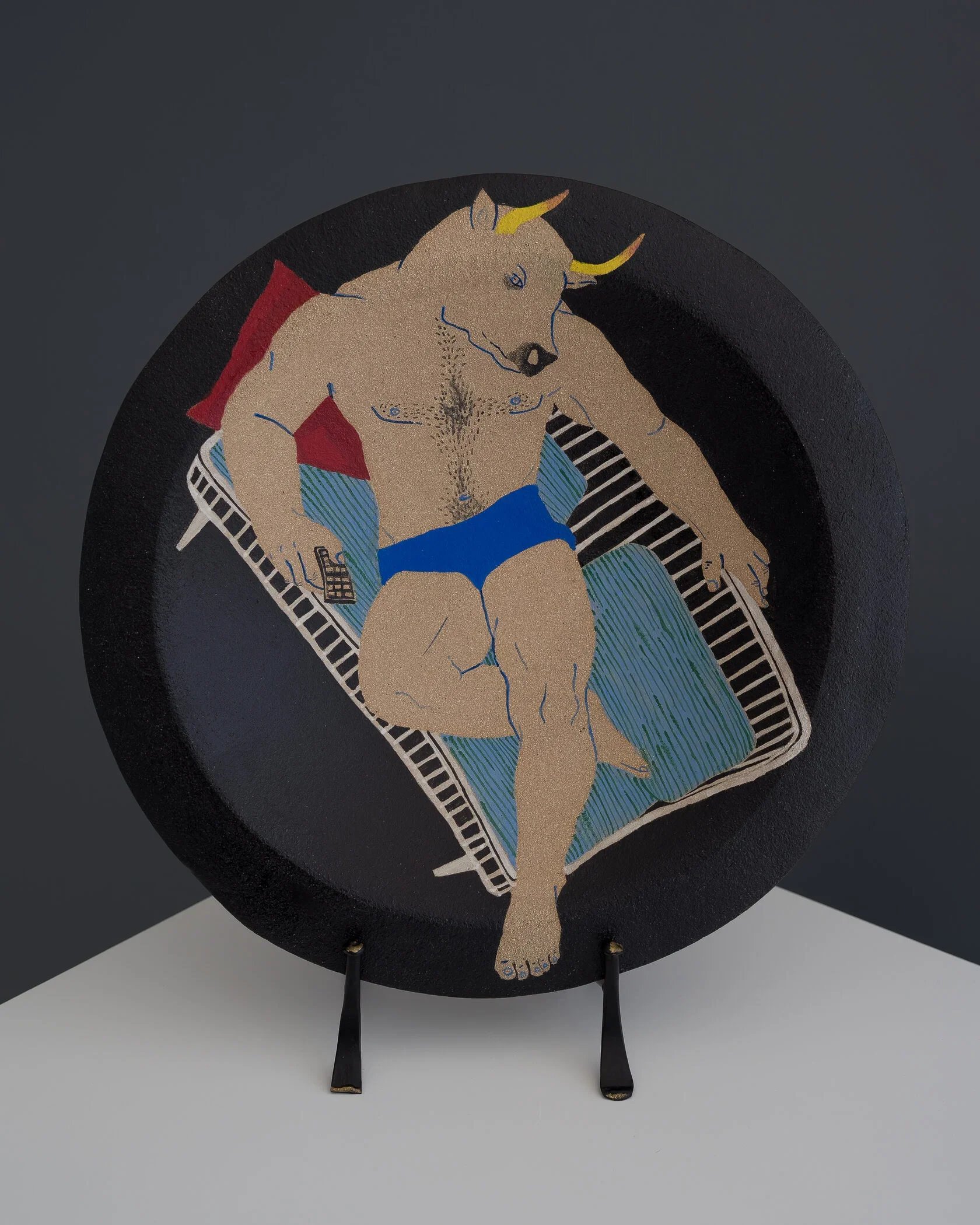
Daphne Christoforou, Minotaur Plate
Across these two floors, Cyprus appears anyway: woven into an ancient alphabet, hidden beneath a curtain of hair, glinting inside a glass sea urchin…
If Souss finds meaning in a word's roots, Ilan Vigo gives words shape. The Israeli poet and multidisciplinary artist describes herself as a ‘visual poet,’ turning Hebrew calligraphy into sculpture. In Nothing New Under the Sun (2023), words from Ecclesiastes wind their way across two meters of brass, twisting and looping until they look almost like a drawing. Without knowing Hebrew, it is easy to get caught up in the shapes and forget, for a moment, that they are words at all.
Vigo’s looping words call back to Julia Astreou-Christoforou upstairs and the ancient characters woven through Cyprosyllabic Script. The languages and histories are different, but the impulse feels familiar. One weaves words into cloth; the other bends them into metal.
So how do you paint a portrait of an island without actually painting it? Perhaps you don’t need to. Across these two floors, Cyprus appears anyway: woven into an ancient alphabet, hidden beneath a curtain of hair, glinting inside a glass sea urchin, bent into brass, and even sprawled across a bed trying to survive the summer heat.
No single work gives the whole picture, and that may be the point. All these contemporary artists offer deeply individual ways to remember, inherit, discover, and imagine the same island. Only a few have made it onto these pages; the others are still waiting, with stories of their own to tell. Both exhibitions run until 1st March 2027, leaving plenty of time to meet the rest. After all, every muse deserves an audience.
VISITING INFO:
GALLERY NAME: XeniArtSpace
ADDRESS: Trilogy West Tower 335, 28th October Ave, 3106, Limassol, Cyprus
DATES: 22 Sep 2026 - 1st March 2027
Photographs by Alina Sparrow